I received and email from Megan Brocco. Many may know Megan and most of you know he father Steve. Megan is going to be testifying before the Washington State Pollution Control Hearings Board. Please read Megan’s email for more information.
Hi All,
Sorry to spam the listserv but I would like your commentary on fishing on the Snoqualmie River (or in the Snoqualmie-Skykomish Watershed). This watershed is the second largest basin draining into Puget Sound and needs your help. If you could send me a statement or just a sentence or two in response to the following, I would be most appreciative.
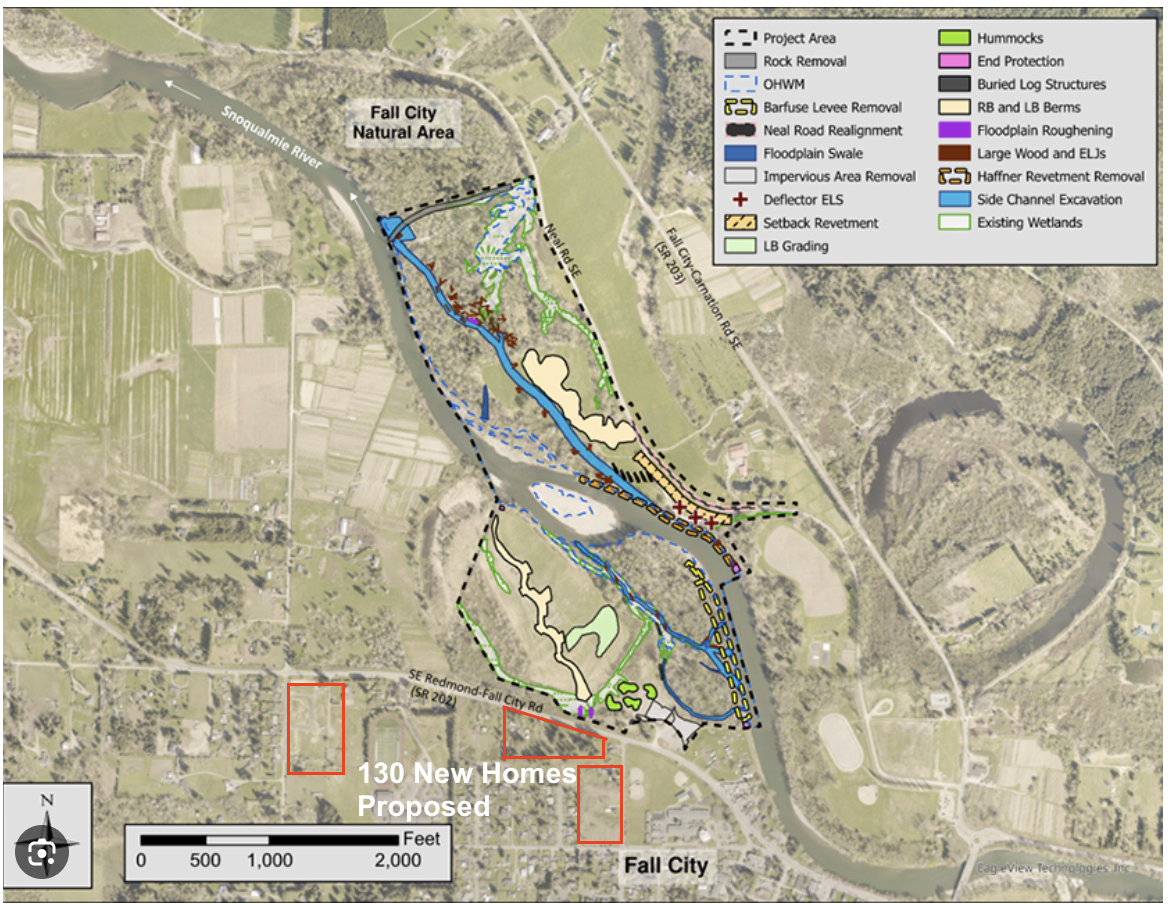
I am testifying before the Washington State Pollution Control Hearings Board to challenge a stormwater permit that discharges pollutants and higher temperature water into the Snoqualmie River. The largest floodplain restoration project in King County was recently completed in Fall City, WA with the goal to improve habitat for spawning and juvenile salmon and steelhead. Within a year of the project’s completion in 2024, ecologists are already finding juvenile Chinook salmon are growing considerably well in their newly restored habitat. A proposed new housing development recently applied to discharge stormwater into this same reach of the Snoqualmie River (right below the bridge in Fall City, development area are the red boxes in the diagram below) where the county just spent $19M+ to restore spawning and rearing habitat. The entire area is a Type I CARA (critical aquifer recharge area), with wetlands, and hydraulic conductivity to the Snoqualmie River. I am contesting this permit. The Washington State Department of Ecology classifies the Snoqualmie River as temperature impaired with the water temperatures too high in many areas to support the needs of trout and salmon. To address this, Ecology established the Snoqualmie River Basin Temperature Total Maximum Daily Load (TMDL). The current stormwater permit does not address temperature – I am arguing that temperature and thermal loading must be considered during permitting (ie. when the EPA and Ecology establish a TMDL for a river of concern, that classifies the temperature of water as a pollutant).
I am curious to know your thoughts and how this proposed project may impact you. I am particularly interested to know:
- If you’ve helped support salmon and steelhead recovery projects in the Snoqualmie-Skykomish Watershed (ie. through Wild Fish Conservancy or another advocacy group)
- If you’ve volunteered in any fish recovery projects
- If you feel a development this close (across the road) from a large salmon recovery project and its wetlands & side channels is detrimental to the goals of the restoration project
- If you fished this area and can comment on your long term observations of fish decline, restoration needed to improve the fishery, and-or hopes for fish recovery
- If you have any science or opinions to share regarding increasing water temperatures or pollution affecting fish
- If you feel financially impacted by the fishability of the Snoqualmie River – ie you pay for a fishing license, guide, teach, take classes, or send customers to this area of the river to fish, cast, learn to fly fish
- What this watershed/river means to you.
- What specific actions you take or believe must be taken by our government to protect our rivers and be good stewards of our resources.
If you’ve spent any time on the Snoqualmie River, I hope you have a few comments to share regarding your experience and steps you’d like to see taken to ensure the health of this river & its fish population going into the future. Your comments are important to help me establish there is broad, community wide support and interest in our fish, restoration projects, and protecting investments of public tax dollars to see the long term success of those dollars.
Please email me directly with your comments or if you have any questions. My goal is to present what this fish habitat restoration project means to the broader community – including a specific focus on the fishing community — and the community wide concerns regarding pollution and discharges into a salmon restoration & recovery area.
Thank you for your time, thoughts and feedback,
Megan
Some bare basic examples of statements that I hope you could expand on include:
- I support salmon-recovery efforts funded by my tax dollars.
- I care about the future of native Snoqualmie salmon.
- I value the ecological benefits salmon provide to our river and wildlife.
- I support restoration projects and want them to succeed.
- I value cold-water refuges and side channels built for salmon near Fall City.
- I am concerned that changes in groundwater quality or temperature can harm salmon habitat.
- I visit the river to observe salmon or teach my children about them.
- I support local and Tribal investments in salmon restoration.
- Salmon are part of Fall City’s heritage and identity.
- Protecting salmon is essential to the health of the Snoqualmie River.
- I fish for salmon or rely on salmon recreation.
- I want future generations to experience salmon in Fall City.
- Salmon-related recreation supports our local economy.